




How to Read Road Signs in the UAE (Dubai & Abu Dhabi)


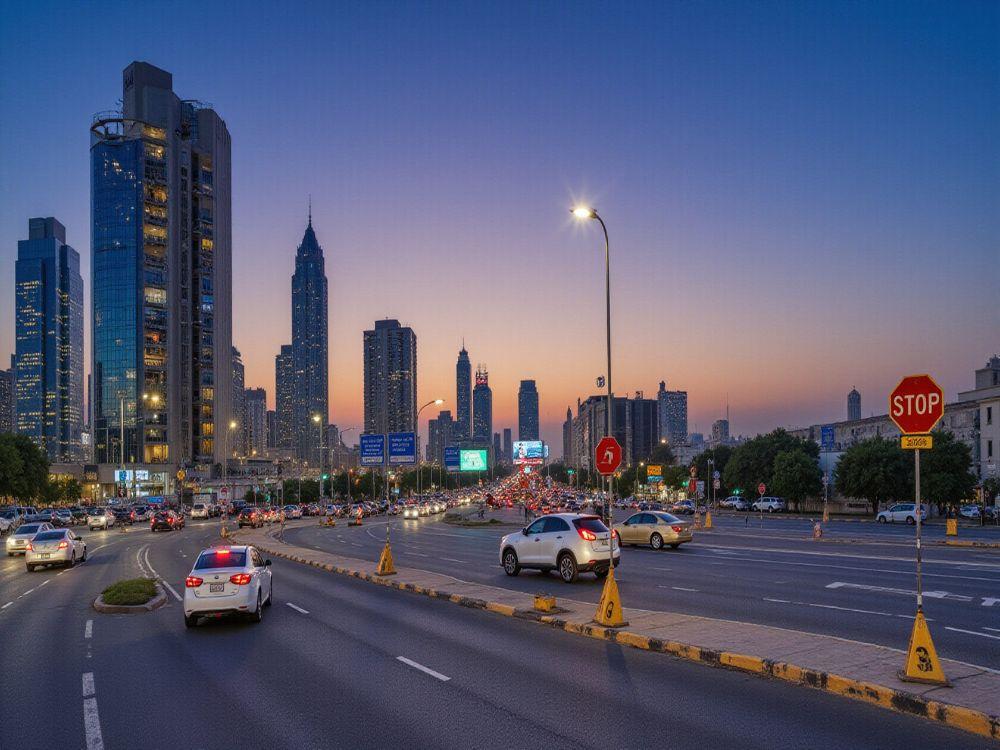
Key takeaways
- Quick Cheat Sheet - How to read UAE road signs in 30 seconds
- Regulatory signs (Rules you must follow)
- Warning signs (Hazards ahead)
- Guide signs (Navigation & destinations)
- Parking control & People of Determination parking
- Freeway / expressway signs
- Road markings in the UAE
- Tips for tourists & first-time drivers
- FAQ
Driving in the United Arab Emirates (UAE) can be a pleasant experience. Modern infrastructure and a well-developed road system ensure comfort. Local drivers and tourists who want to rent a car in Abu Dhabi should be familiar with road signs. It protects their safety and the safety of other road users, helping avoid fines. In the UAE, road signs use international symbols, often accompanied by Arabic and English text. Below, we'll discuss the different colors and shapes of local road signs to help you feel confident on the highways.
Quick Cheat Sheet - How to read UAE road signs in 30 seconds

Driving in the UAE is highly organized. All signage complies with international standards and uses clear color coding. In the table below, we have collected the most common types of signs and their meanings.
| Shape | Color | Meaning | Action |
| Circle | Red border | Prohibitory | It is prohibited to do what is shown. |
| Circle | Blue | Mandatory | You must follow such an instruction. |
| Triangle | Red border | Warning | It warns of danger ahead or changes on the road. |
| Rectangle | Blue or green | Information | It provides information on navigation, exits, and distances to cities. |
| Octagon | Red | Stop | The driver must stop and give way to all traffic. |
| Diamond | Yellow or orange | Road Works | It shows temporary hazards or construction zones. |
Knowing these rules allows you to understand the necessary action quickly.
Regulatory signs (Rules you must follow)
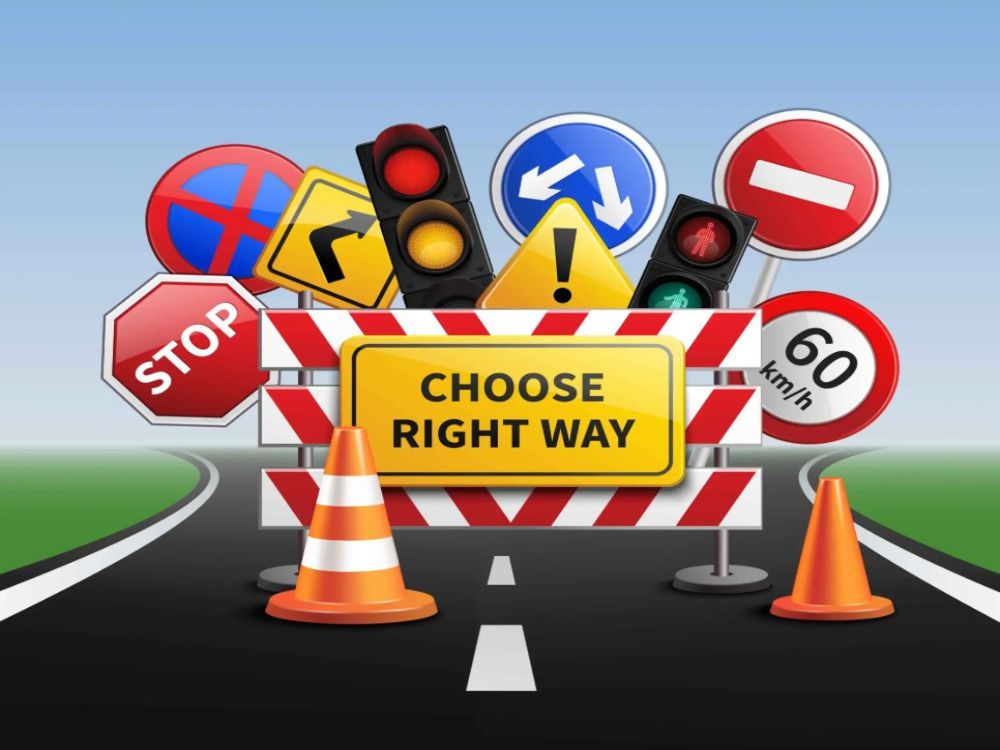
Regulatory signs are the "law of the road." They provide clear orders, not recommendations. Prohibitory signs tell you what is forbidden. The red border is a stop signal for the indicated action. Mandatory signs, or blue circles, indicate what you must do. They are most often installed at junctions to ensure safe traffic flow. Ignoring such signs can result in fines or black points on your driver's license.
Control signs
They allow traffic to flow in accordance with pedestrian and driver instructions. The list of basic control signs includes:
STOP. Drivers are required to come to a complete stop and ensure the road is clear of obstructions before proceeding.
GIVE WAY. It typically means drivers must yield to cyclists observed crossing close by.
NO ENTRY. This sign restricts entry to a specific road or section.
The main problem with these signs is that drivers don't always check the stop line and sometimes brake late.

Mandatory signs
These signs inform drivers of necessary actions and the need to adhere to traffic rules. Mandatory signs explain the route drivers must take and the minimum speed they must maintain. We decide to analyze some examples.
- Straight-ahead traffic. Drivers must drive straight ahead and cannot turn left or right.
- Right-turn traffic. This sign informs drivers that they must turn right.
- Overtaking from either side. Drivers can navigate around an obstacle in any way that is most convenient for them.
If you see a "Keep Right" arrow, you must move to the right of the upcoming obstacle and avoid passing on the left.
Another example is a "Left Turn Only" arrow at a traffic light. If you realize you were planning to go straight, don't change your mind at the last second. You can complete the turn and find a place to turn around later.
Prohibitory signs
They restrict specific actions to ensure road safety and order. Prohibitory signs prevent drivers from committing inappropriate actions. Let's consider the following examples.
- No U-turn. A U-turn in the middle of the road is unavailable.
- No overtaking. Overtaking other vehicles is prohibited.
- No right/left turn. Cars are prohibited from turning in the indicated direction.
- Speed restriction sign. The sign indicates the maximum speed at which cars can travel on the road.
A common mistake tourists make is confusing a prohibition with a recommendation and ignoring "no entry" signs.
Warning signs (Hazards ahead)

Warning signs in the UAE alert drivers to upcoming changes in road conditions. It gives people more time to adjust their driving style before encountering a hazard. As a rule, such a sign is represented in the form of a triangle.
When you see this sign, slow down in advance. If there's a sharp turn or speed bump ahead, apply the brakes gently.
We also recommend doubling the distance between you and the vehicle in front. If the vehicle brakes abruptly due to a hazard, you'll have ample time to react.
Advance warning signs
Such warning signs alert drivers to potential hazards along their route. The information is essential for drivers preparing for traffic lights, roundabouts, merging traffic, and more.
Diagrammatic warning signs
These signs warn drivers of potential hazards or changes in traffic conditions with symbols or illustrations to convey specific warnings. They are triangular with a red border to encourage caution behind the wheel. Common examples of such signs include merge or narrow lane patterns, bus or tram routes, and so on.
Hazard marker signs
They help mark physical hazards, including bridges and road barriers. Chevron boards inform drivers that they may encounter structures or obstacles on the road.
Guide signs (Navigation & destinations)
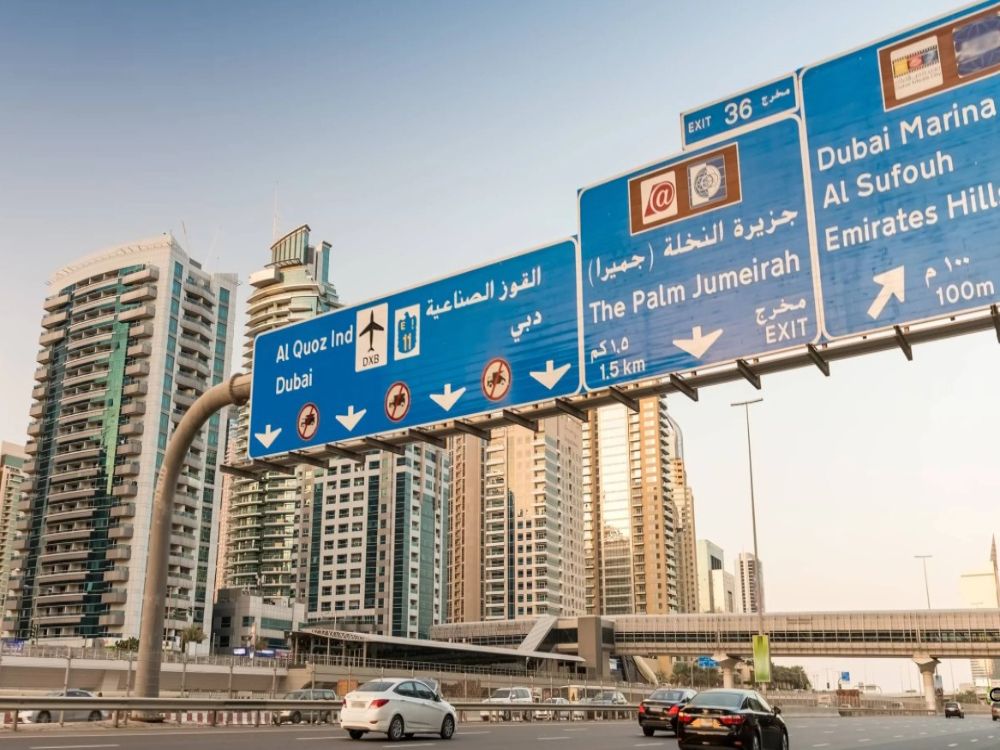
It is another crucial category of road signs that provide drivers with directional and navigational information. Their primary purpose is to guide drivers to their destination.
Trailblazing / route signs
Drivers may see trailblazing signs along key roads in the UAE. They are erected along the route to help tourists know they're on the right path. A popular example is the sign depicting an airplane pointing to Dubai International Airport. You'll also find signs directing you to other local attractions.
Exit direction signs
They help drivers determine the optimal lane to take when approaching an exit. With these signs, cars can exit a freeway or other road without confusion or abruptly swerving into oncoming traffic.
Signs indicating lane use or exit are shown as white panels that reveal a lane moving away from the main road.
Parking control & People of Determination parking
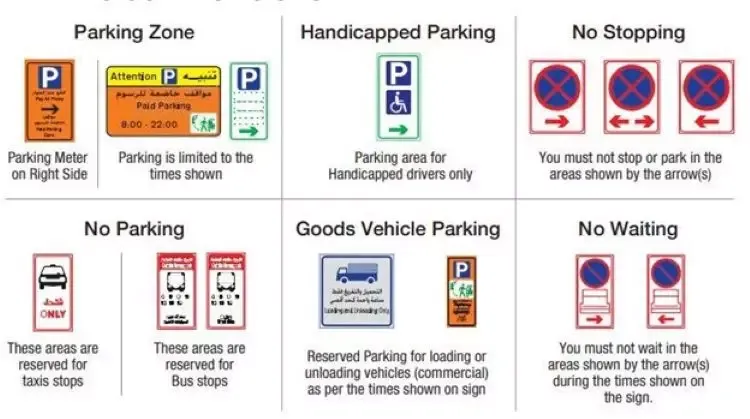
In the UAE, parking signs indicate where parking is permitted and prohibited. They indicate time limits and other important information. Tourists often forget that such time restrictions apply even when they are in a car.
Parking zone. Parking is permitted in this location.
Stopping and parking are prohibited. Parking is prohibited here under any circumstances.
Dedicated parking zones for people with disabilities make a significant contribution to inclusivity. These are typically blue signs with a wheelchair image. It means only drivers with disabilities are allowed to park here.
Freeway / expressway signs

Freeway signs indicate the beginning and end of the freeway. They are utilized at points where drivers must slow down to merge with traffic.
At the beginning of the freeway, higher speed limits and special traffic rules apply. At the end of the highway, such signs warn drivers to slow down as they merge onto roads with lower speed limits.
You must read the signs in advance to adjust your speed and driving style.
Road markings in the UAE
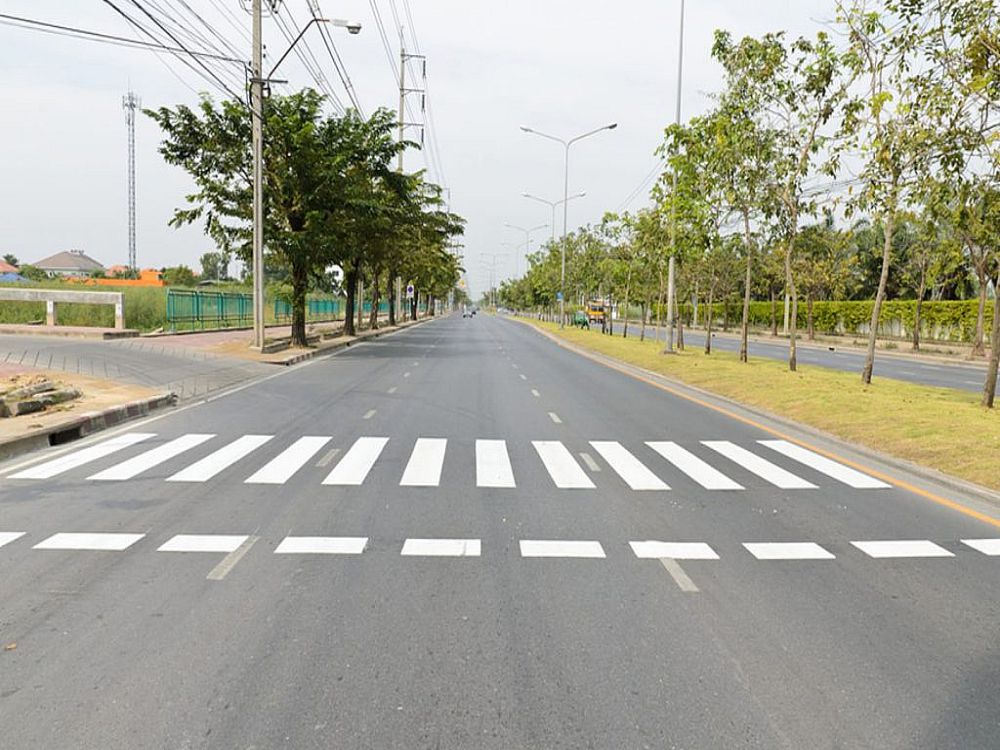
Road markings in the UAE comply with international standards to ensure consistency for residents and foreign tourists renting luxury cars.
Lane markings allow drivers to navigate multi-lane roads without interruption. A solid white line separates vehicles traveling in the same direction. Drivers are not allowed to cross it. A broken white line between lanes will enable drivers to change lanes safely.
Arrows and symbols on roads serve as guides for drivers. Directional arrows indicate the direction of travel in a given lane, including right or left turns. Merge signs urge drivers to change lanes carefully.
Stop markings help regulate traffic at intersections or pedestrian crossings. These thick white lines indicate to drivers that they must come to a complete stop before entering the intersection.
We recommend using GPS before starting the engine. Some intersections in the UAE have 5 or 6 lanes. If you know which lane you need to be in 2 km in advance, it will prevent panic on the road.
The box junction is a yellow crisscross grid painted in the middle of an intersection. It warns drivers not to enter this area unless the exit is clear to prevent traffic jams and gridlocks.
Tips for tourists & first-time drivers
Driving in the UAE for the first time can seem challenging due to high speeds and multi-lane highways. We've compiled a few tips to help relieve stress.
- Never try to "catch" an exit at the last second by crossing multiple lanes. UAE highways are designed with frequent U-turns. It's easier and cheaper to drive 3 km and take the next exit than to get into an accident.
- Master roundabouts. Remember to give priority to cars already inside the circle.
- Maintain the "safe zone." Braking distances increase on high-speed highways. Even if the driver behind you is flashing their headlights, focus on maintaining a safe distance between you and the car in front.
- Smooth driving. Avoid sudden braking or abrupt lane changes. Remember to use your turn signals at least 3 seconds before moving.
- Read parking signs carefully. Check the orange and blue signs for the zone code and operating hours.
These recommendations will increase your safety and help you avoid fines.
FAQ
Are road signs in the UAE in English?
The primary language for road signs in the UAE is Arabic. At airports, landmarks, and other important public places, such information is also posted in English. Foreign tourists will easily understand any road sign.
What do circular signs mean in Dubai?
Circular signs in Dubai are regulatory. They tell drivers what to do and what to avoid. Blue circles indicate mandatory actions (e.g., left turns), while circles with a red border indicate prohibitions (e.g., no turns).
Whats the difference between mandatory and prohibitory signs?
In the UAE, mandatory signs are circular with blue backgrounds. They tell drivers what they must do, e.g., "Turn Right Only". In contrast, prohibitory signs are usually circular with red borders and white backgrounds. They inform drivers what they must not do, e.g., "No Overtaking".
What should I do if I miss an exit on a highway?
If you miss an exit on a Dubai highway, we recommend staying calm and driving safely to the next available exit. You can then use local roads or the next U-turn to return. Remember that stopping, reversing, or making sudden maneuvers are traffic violations and will result in fines.
How do I understand guide signs and arrows before an exit?
In the UAE, drivers encounter bilingual signs and color-coded markings, including blue for national routes and green for local ones. These indicate destinations and exits ahead. Advance signs appear 1-2 km before the exit and list the destinations in order, along with route emblems and arrows. Closer to the exit, arrows above the road indicate the correct lanes: straight arrows for straight ahead and curved arrows for detours.
What do warning triangles usually indicate?
Warning triangles (red-bordered, triangular signs) alert drivers to potential hazards, including sharp curves, pedestrian crossings, T-junctions, etc. Drivers must slow down and be cautious.
How do parking control signs work (time limits, zones)?
Parking control signs inform drivers where they are permitted to park and where they are prohibited from parking. You may also notice time restrictions on the signs. These determine how long your vehicle can be parked in a particular spot. Parking zones in the UAE indicate where you can park, often with time restrictions.
What does STOP require in practice (line, full stop)?
In the UAE STOP requires a complete stop behind the solid white stop line, not a rolling stop. This gives priority to other traffic and pedestrians. Drivers can proceed only once the road is clear.
Are temporary roadwork signs different in the UAE?
Yes, temporary roadwork signs in the UAE differ from standard ones. Typically, they use an orange background with black symbols or text to indicate construction work or temporary changes.
What are the most common mistakes tourists make with UAE road signs?
Tourists often misunderstand UAE road signs. They misread traffic rules at roundabouts, fail to use turn signals, and speed, leading to fines and accidents.
Recent Articles
- Dubai Road Trip Guide: Best Routes from Dubai
- Best SUV in UAE: Top Picks for 2026
- Dubai Driving Licence Renewal: Complete Guide
- Porsche 911 vs Lamborghini Huracán in Dubai: Which Sportcar Works for Every Day?
- UAE Number Plates Explained: Types, Costs, Colors & How They Work
- Tips for Your First-Time Renting Luxury Car in Dubai
- Dubai Police Luxury Supercar Fleet: What’s Included & Where to See Them